SASSA SRD 370 Approved But No Payment Date Is Mentioned – Reason & Solution
One of the most confusing experiences for SASSA SRD beneficiaries is seeing their status marked as “Approved” after SASSA Status Check but without any pay date. This leads applicants to believe something is wrong, or that SASSA withheld their payment for unknown reasons. In reality, the delay between approval and the assignment of a pay date is part of a normal process known as the reconciliation gap.
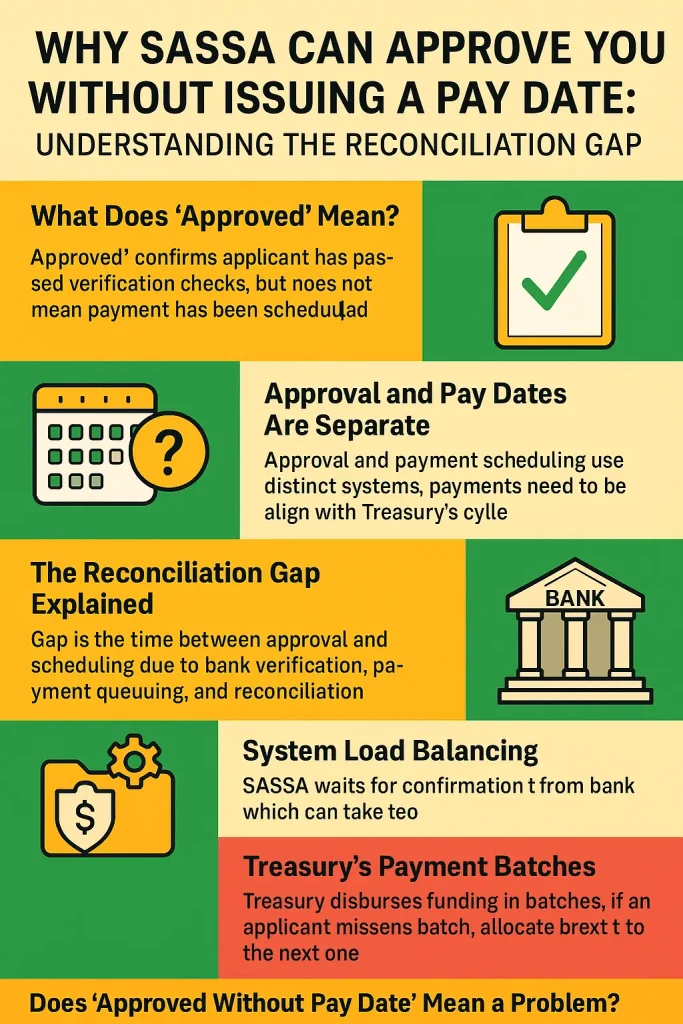
The reconciliation gap occurs because approval and payment are handled by two separate internal systems. While approval confirms that a person qualifies for the SRD grant for that month, the payment process involves additional layers of bank verification, system queueing, load balancing, and reconciliation with Treasury’s payment batches. This gap varies from person to person, which is why some applicants receive their pay dates quickly while others wait longer.
What Does “Approved” Actually Mean?
When SASSA marks an application as approved, it means the applicant has passed all core verification checks. These include identity matching with Home Affairs, financial screening, movements in the applicant’s bank account, and cross-checking with UIF, NSFAS, and government salary databases.
However, approval alone does not mean the payment has been scheduled. Approval only confirms eligibility. The actual release of funds depends on a separate set of processes.
Why Approval and Pay Dates Are Separate
The SRD grant is unusual compared to other SASSA grants because its systems are more dynamic and data-dependent. For example, older persons’ and disability grants follow a predictable payment cycle, but the SRD grant must verify every applicant every month. Because of this, payments must be aligned with the Treasury disbursement cycle and bank-clearing windows.
These two systems verification and payment do not always sync at the same speed. When verification finishes before payment scheduling, applicants see “approved” without a pay date.
The Reconciliation Gap Explained
The reconciliation gap is the time between approval and payment scheduling. During this window, SASSA’s backend system performs several additional tasks:
- It verifies that bank account details are active, valid, and aligned with the applicant’s ID.
- It confirms that the chosen payment method is still safe and consistent with previous months.
- It queues approved profiles in batches for payment allocation.
- It syncs data with Treasury to ensure the applicant’s funds are included in the correct disbursement cycle.
- It aligns the payment with the applicant’s bank’s processing timetable.
Because these tasks take place after approval, the reconciliation gap is a normal part of the SRD process though the length of the gap differs for every applicant.
Bank Verification Timing
Even after approval, SASSA must wait for the bank verification results to return from the financial institution. The bank must confirm that the applicant’s:
- Name
- Surname
- ID number
- Account status
match the information submitted to SASSA. While this seems instant, banking partners return verification data in batches, not in real time. If your verification batch is delayed, your pay date will also be delayed.
Some banks have faster feedback cycles than others, and some provinces have slower banking infrastructure. This is why two people with the same bank may still receive their pay dates days apart.
Time Difference Reasons
During high-volume periods such as the beginning of a new month or a public holiday SASSA’s systems prioritize verification over payment scheduling. The system reduces load by approving applicants first, then assigning pay dates once the verification wave is complete.
This explains why many people see “approved, no pay date” early in the month. Payment scheduling picks up after the main verification wave has passed.
Treasury
Even after the bank confirms the account, SASSA must align its payments with Treasury’s cycle. Treasury releases funding in batches, and these batches dictate the earliest possible payout. If an applicant’s approval misses the current batch, they are automatically pushed into the next available one.
This is why some applicants see late-month pay dates even if they were approved early in the cycle.
Two Approval, Different Paydays
Although two applicants may be approved simultaneously, the reconciliation gap varies based on several factors:
- how quickly their bank returns verification
- when their data enters the payment queue
- their bank’s clearing time
- whether Treasury’s cycle is open or closed at that moment
- regional processing capacity
- risk-based payment routing
These factors combine to create pay date differences even among applicants with identical approval times.
Approved Without Pay Date
No. It is one of the most common SRD statuses. It means simply that your payment is not yet scheduled. Unless your status changes to “referred” or “bank verification pending,” you do not need to update anything. The absence of a pay date does not indicate a decline, risk flag, or problem with your account.
Payment Dates
Most applicants receive their pay date between 1 and 10 days after approval. In high-volume months, it may take longer. Delays are rarely caused by the applicant and usually relate to bank verification timing or Treasury’s payment cycle.