How To Solve Identity Verification Failed Even When Details Are Correct
Seeing “Identity Verification Failed” when all your details are correct is one of the most frustrating experiences for applicants dealing with the SASSA. Social media is filled with people saying the same thing: “My ID is valid, my name is correct, my number is right so why did I fail?”
What makes this problem worse is that most explanations online quietly blame applicants. In reality, many identity verification failures have nothing to do with mistakes made by the applicant. They are usually caused by how multiple government and financial systems talk to each other behind the scenes.
Understanding this properly helps you fix the issue instead of repeating actions that make delays worse.
What Identity Verification Actually Means
Identity verification is not a simple ID number check. It is a multi-system comparison process.
Your application details are compared against several databases to confirm that:
- Your identity exists in official records
- Your personal details match across systems
- Your ID is active and not flagged
This process is automated. No human manually checks your documents at the first stage. Because of that, even small data inconsistencies across systems can trigger a failure.
Why Verification Can Fail Even If Your Details Are Correct
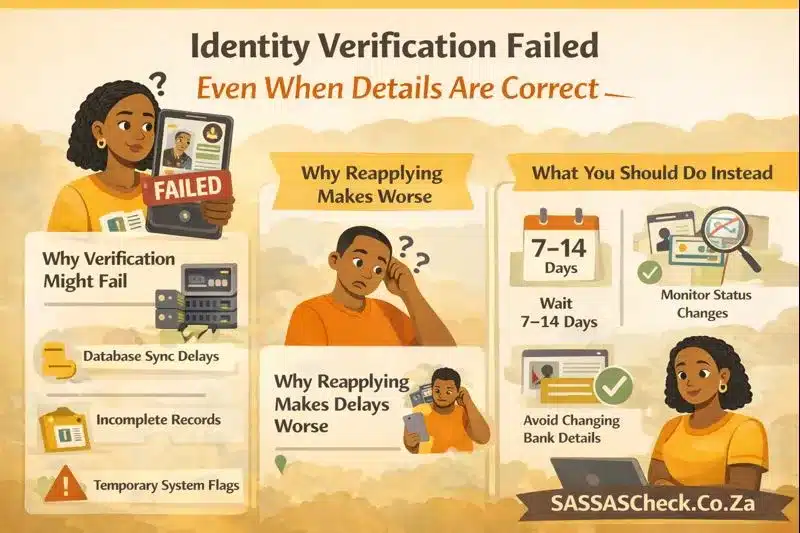
Database Sync Delays
One of the most common causes is data synchronization delays between systems. Government databases are not updated in real time. If your details were updated recently such as a name correction, marital status change, or ID reissue one system may reflect the update while another still shows old information.
When systems don’t match perfectly, verification fails automatically. This happens even when your information is legally correct.
Incomplete Historical Records
Some identity records are incomplete, especially older ones. This is common for applicants whose IDs were issued many years ago or whose details were captured manually in the past.
When newer systems try to validate older records, missing fields or formatting differences can trigger a failure without clearly explaining why.
Temporary System Flags
Sometimes verification fails due to temporary flags, not permanent issues. These flags can be caused by:
- Bulk system audits
- Security rechecks
- High application volumes
In these cases, the failure does not mean rejection. It simply means the system paused your application for further review.
Why Reapplying Usually Makes It Worse
Many applicants immediately reapply when they see an identity verification failure. Unfortunately, this often extends the delay.
Each reapplication creates a new record that must go through the same checks again. If the underlying system issue has not resolved, the new application fails in the same way. This creates a loop of repeated failures, increasing frustration without solving the root problem.
The Role of Linked Details
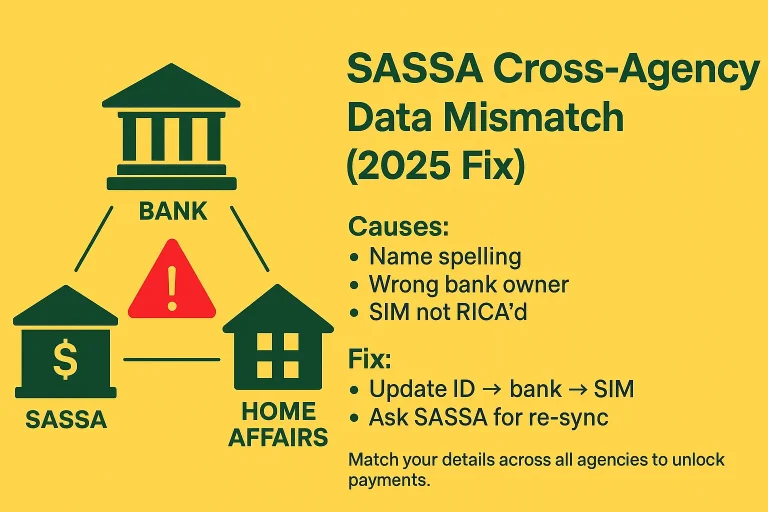
Identity verification does not stop at your ID number. The system also checks linked information, such as:
- Mobile number ownership
- Banking account holder name
- Previous application history
If any of these do not align perfectly with your identity record, verification can fail even when your ID itself is valid. For example, a bank account registered under a slightly different name format can trigger an identity mismatch.
What You Should Do After an Identity Verification Failure
Give the System Time
In many cases, verification failures resolve on their own within 7 to 14 days. System rechecks happen automatically, especially after updates or audits. Acting too quickly often interrupts this process rather than helping it.
Keep Your Details Stable
Avoid changing personal or banking details repeatedly. Stability allows the system to complete its checks without restarting verification cycles. Frequent changes can signal inconsistency and prolong the review.
Monitor Status Changes
If your status changes from failed back to pending or approved, it usually means the system successfully rechecked your details. This is a good sign, not something to worry about.
When You Should Take Action
Action becomes reasonable when:
- The failure remains unchanged for more than 30 days
- The system repeatedly fails without status movement
- A new decline reason appears alongside the failure
At this stage, escalation through official support channels may be appropriate, but only after allowing enough time for automated processes to finish.
Common Myths That Cause Confusion
Many people believe identity verification failures mean:
- Their ID is invalid
- Someone used their identity
- Their application was secretly rejected
In most cases, none of these are true. The system is cautious by design and often pauses applications simply because information could not be matched instantly.
Final Reality Check
Identity verification failures are system-based problems, not personal failures. When your details are correct, the issue is usually timing, synchronization, or system logic not eligibility.
Patience combined with stable information is often the fastest way forward. The system eventually catches up, even if it does not explain itself along the way. Understanding this prevents unnecessary reapplications and reduces delays caused by panic-driven actions.
FAQs
Why does identity verification fail when my ID is valid?
Because verification checks multiple systems, not just your ID. If databases don’t sync perfectly, failures occur even with valid details.
Should I reapply after an identity verification failure?
Usually no. Reapplying often repeats the same failure and delays processing further.
How long does identity verification take to fix itself
Most cases resolve within 7 to 14 days. Complex cases may take up to 30 days.
Can changing bank details fix identity verification issues?
Not always. In some cases, changing details creates new mismatches and extends delays.
Does identity verification failure mean I was rejected?
No. A failure is not the same as a decline. It usually means the system could not complete verification yet.